project 13
Independent Verification of Enterprise Based Training (EBT) under ASSET Project
Duration: May 2026 – December 2026
Client: Directorate of Technical Education, Ministry of Education, Bangladesh
Sample Size: 7000 questionnaire survey, 100 employer verification, 30 FGDs, 60 KIIs, 30 IDIs, 100 site observation checklists, and 100 Fiduciary compliance checklists
Responsibilities: Survey Tools Design, Field Team Supervision, Developing ODK, Database Management, Data Analysis, and Writing the Report.
The project website can be visited. Here
Contributing to this project while working at Bangladesh Institute of Social Research Trust
- R codes for preparing population database for sampling worthy
- Interactive Excel forms and KoboToolbox questionnaires for trainees, institutions, and employers.
- STATA codes for data cleaning and demographic information
Executive Summary
Introduction
The Independent Verification of Enterprise-Based Training (EBT) is being conducted under the Accelerating and Strengthening Skills for Economic Transformation (ASSET) Project of the Directorate of Technical Education (DTE), Government of Bangladesh. The study is implemented by BISR Consultants Ltd., in a joint venture with Shahidul Consultant Ltd. It aims to assess the quality of training, compliance with project guidelines, financial management, social inclusion, and employment outcomes. The findings will help identify gaps in implementation and suggest ways to improve future training activities.
The study follows a mixed-methods approach. It combines quantitative surveys with qualitative interviews, focus group discussions, and site observations. It also examines training records, institutional practices, financial compliance, occupational health and safety, and the participation of women, persons with disabilities, and ethnic minority groups. The overall aim is to understand how EBT is being implemented and whether it is meeting its intended objectives.
Progress to Date
The study team has completed the survey of 1,000 current trainees and 100 training institutions (of round 1). These surveys provide preliminary information on trainee backgrounds, training delivery, attendance, training materials, safety measures, satisfaction, institutional performance, industry contributions, and the challenges faced by training providers. The findings offer an initial picture of how EBT operates across different training types, sectors, and locations.
The survey of 2,000 graduates is still ongoing (of round 1). This part of the study will help assess graduates’ employment status and the relevance of their acquired skills. The report presents preliminary findings from the completed trainee and institutional surveys. These findings will be further strengthened through the remaining fieldwork, data verification, and analysis.
Methodology
The study uses a mixed-methods approach to independently verify the implementation, quality, compliance, inclusiveness, and employment outcomes of Enterprise-Based Training (EBT) under the ASSET Project. It combine quantitative surveys, qualitative interviews and discussions, desk reviews, tracer studies, site observations, and fiduciary compliance checks. The assessment examines adherence to the Enterprise-Based Training Operational Manual (ETOM, 2025), approved training proposals, Performance-Based Grant Agreements (PBGAs), and other relevant project requirements. Evidence from multiple sources will be triangulated to validate reported information, identify implementation gaps, and generate recommendations for the Project Management Unit (PMU) and the Directorate of Technical Education (DTE).
Planned data collection and sample sizes
The study will be conducted in two rounds, with quantitative and qualitative methods implemented alongside document review and compliance verification. The planned coverage and activities are as follows:
| Component | Planned sample / volume | Purpose |
|---|---|---|
| Round 1 | 3,000 trainees: 2,000 graduates and 1,000 current trainees | Assess training implementation, quality, participation, inclusion, and outcomes |
| Round 2 | 4,000 trainees: 3,000 graduates and 1,000 current trainees | Extend verification to a new cohort and assess employment and retention outcomes |
| Institutional survey | 100 institutions (in each round) | Assess institutional capacity, training delivery, facilities, compliance, and implementation challenges |
| Employer verification | 100 employers | Verify reported employment, retention, and the relevance of acquired skills |
| Site observations | 200 training sites: 100 per round | Verify training facilities, instruction, attendance, accessibility, and safeguards |
| Key Informant Interviews (KIIs) | 60 interviews | Gather evidence from government and project officials, industry partners, training providers, trainers, assessors, and experts |
| Focus Group Discussions (FGDs) | 30 discussions, with 8–12 participants per discussion | Explore shared experiences and perspectives among trainees, training providers, trainers, and employers |
| In-depth Interviews (IDIs) | 30 interviews | Examine individual experiences, employability challenges, and the circumstances of vulnerable trainees |
Sampling, data collection, and verification
A stratified random sampling strategy will be applied across the priority sectors—Agro-Food, Ceramics, Construction and Civil, Furniture, Garment, Textile and Leather, Health, ICT, Light Engineering and Manufacturing, and Tourism and Hospitality—and the relevant training types, including TSTP, ADTP, and SUTP. The sample will account for urban, rural, and disadvantaged locations, with a target of at least 40% women, 5% ethnic minorities, and inclusion of all available trainees with disabilities. The two rounds will use non-overlapping trainee samples. The 100 employer interviews will be selected from employed graduates, while 100 training sites will be assessed in each round using structured compliance checklists.
The qualitative component will include 60 KIIs with relevant institutional and industry stakeholders, 30 FGDs with 8–12 participants each, and 30 IDIs prioritizing vulnerable women, ethnic minorities, persons with disabilities, and other relevant trainees and trainers. In addition, the team will review operational manuals, approved training proposals, training agreements, curricula, attendance and assessment records, financial documents, stipend disbursement records, and relevant project information systems. Site visits and fiduciary checks will compare documented compliance with actual conditions, including training delivery, trainer qualifications, equipment, financial utilization, trainee attendance, accessibility, occupational health and safety, and grievance redress mechanisms.
Multistage Stratification
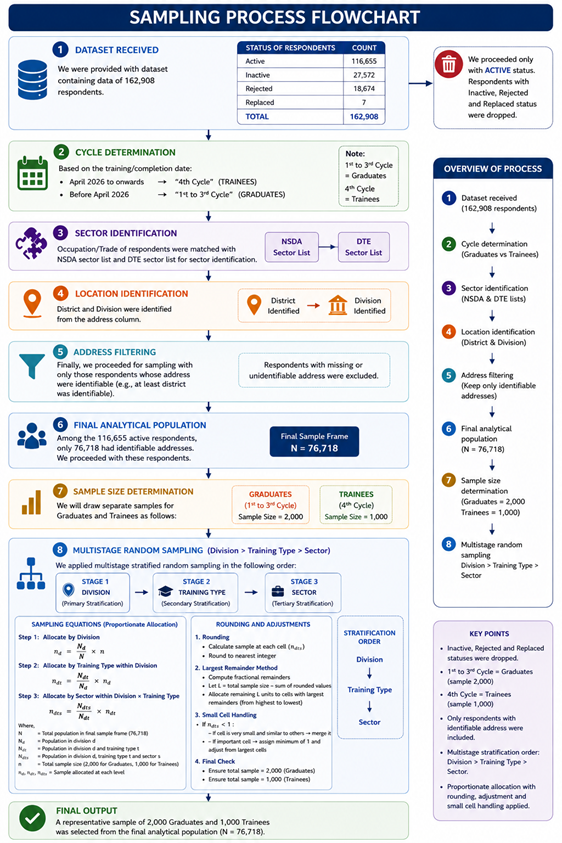 Figure: Multistage Stratified Random Sampling Process
Data management, analysis, and reporting
Data will be collected digitally using KoboToolbox, following enumerator training and pre-testing of the instruments. Quantitative datasets will be edited, cleaned, coded, and analysed using STATA, while qualitative data will be analysed thematically. Findings will be triangulated across surveys, administrative records, employer confirmations, interviews, and direct observations. Respondents’ consent, confidentiality, and anonymity will be protected, and data will be retained securely for at least five years. The final outputs will include separate reports for Rounds 1 and 2, a consolidated report synthesizing findings from both rounds, cleaned datasets, analysis syntax, sampling frames, metadata, and data collection tools.
Planned Activities
The immediate priority is to complete the graduate survey and other essential field activities. The progress report sets the second week of October 2026 as the target for completing this work. The next steps include checking and cleaning the collected data, conducting detailed analysis, and combining quantitative and qualitative findings. The team will also examine compliance gaps, inclusion and accessibility, financial practices, and employment outcomes.
After completing the fieldwork and analysis, the team will prepare the Round 1 draft report. It will present the findings, identify key challenges, and provide practical recommendations. The draft will be shared with the Project Management Unit (PMU) and DTE for feedback. The final Round 1 report will then be revised and submitted with cleaned datasets, analytical tables, and supporting evidence.
The assignment will subsequently move to Round 2, which is planned to cover 4,000 trainees, including 3,000 graduates and 1,000 current trainees. The second round will also include further verification of training institutions, employers, and training sites. The findings from both rounds will be combined in a consolidated report. This report will highlight major trends, lessons learned, good practices, and recommendations for strengthening future EBT activities. The final outputs will also include cleaned datasets, questionnaires, sampling information, metadata, and other relevant research tools.